
Key Takeaways
- A remote Animator role attracted 44 applications through Teamified's hiring platform.
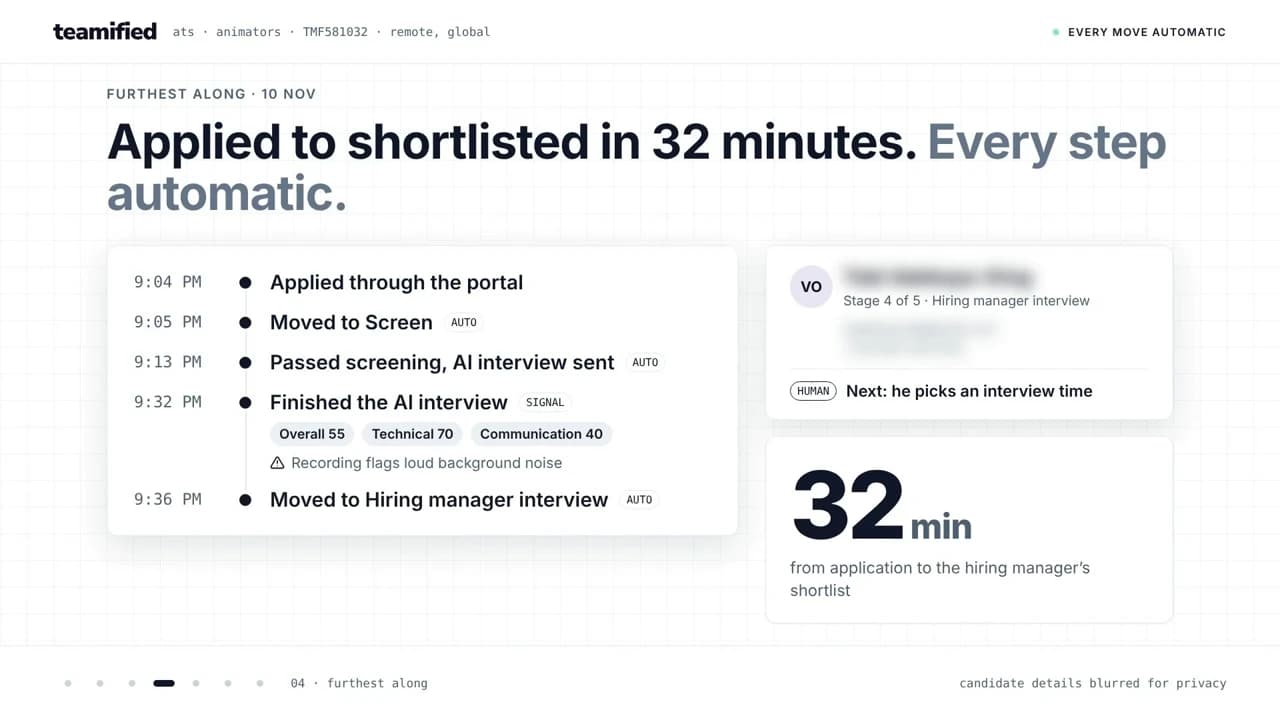
- One candidate reached the hiring manager's shortlist in 32 minutes, including a 12-minute-and-31-second AI interview. This is one candidate's result, not an average or guarantee.
- AI screening, interviews and configured pipeline rules handled candidate progression without manual stage changes in this workflow.
- Job-specific scoring rubrics show supporting evidence and gaps that recruiters can investigate; missing evidence does not necessarily mean a candidate lacks a skill.
- Hiring managers remain responsible for reviewing candidates and making final hiring decisions.
44 applications. Automated candidate screening and interviews. One candidate reached the hiring manager's shortlist in just 32 minutes, without manual candidate stage changes.
How much time does your hiring team spend reviewing resumes, screening applicants, and arranging interviews?
For one business using Teamified, AI recruitment automation helped manage these tasks automatically.
On 5 November 2026, the business posted a remote Animator role open to applicants worldwide. The job attracted 44 applications through Teamified's hiring platform.
Teamified's AI agents screened applicants, assessed their qualifications, conducted interviews, and moved candidates through the configured hiring pipeline.
One candidate applied at 9:04 PM and reached the hiring manager's shortlist at 9:36 PM.
That's 32 minutes from application to shortlist, including a 12-minute-and-31-second AI interview.
Here's how the process worked.
The results at a glance
| Hiring metric | Result |
|---|---|
| Position | Remote Animator |
| Job posted | 5 November 2026 |
| Total applications | 44 |
| Candidate application time | 9:04 PM |
| Candidate shortlisted | 9:36 PM |
| Application-to-shortlist time | 32 minutes |
| AI interview duration | 12 minutes, 31 seconds |
| Candidates reaching hiring manager interview stage | 1 |
| Manual candidate stage changes | 0 |
| Final hiring decision | Human-controlled |
The 32-minute result reflects one candidate's experience, not an average or guaranteed processing time.
Watch how Teamified automated the hiring process
See how a real Teamified client used AI recruitment automation to screen, score, and interview applicants.
Video: A real customer hiring workflow showing how Teamified's AI agents screened, scored, and interviewed candidates. Candidate information has been blurred to protect privacy.
The challenge: Screening applicants without slowing down recruitment
Finding qualified candidates takes more than reviewing resumes.
Hiring teams must compare skills, assess experience, identify missing qualifications, and decide which applicants should move forward.
When these tasks are handled manually, recruiters spend valuable time reviewing applications, updating candidate records, and coordinating interviews.
For this Animator role, the business needed a consistent way to evaluate applicants while keeping recruitment moving.
Teamified's AI-powered applicant tracking system (ATS) helped automate the initial screening and interview process.
How Teamified's AI recruitment automation worked
The business created its job posting on Teamified and defined the criteria used to assess applicants.
Once applications arrived, the platform's AI agents and configured workflow rules managed the initial recruitment stages.
1. AI screened and scored applications
Candidates applied through the Teamified jobseeker portal.
Each application was evaluated against the job's scoring rubric, which considered relevant skills, experience, and role requirements.
This helped the business assess applicants consistently instead of relying only on how well their resumes were written.
Learn more about AI candidate screening and verification.
2. Qualified candidates progressed automatically
The business's configured hiring rules determined which applicants could move to the next recruitment stage.
Candidates who met the required criteria progressed automatically.
Recruiters did not need to manually change candidate stages during this workflow.
This reduced repetitive administrative work while keeping the hiring process structured.
3. AI conducted candidate interviews
Candidates who progressed to the interview stage were assessed using Teamified's AI interview capability.
For the candidate highlighted in this case study, the AI interview lasted 12 minutes and 31 seconds.
The interview gathered additional information that could be reviewed alongside the candidate's application and scoring results.
Learn more about AI-powered candidate interviews.
4. One candidate reached the shortlist in 32 minutes
One candidate submitted an application at 9:04 PM.
By 9:36 PM, the candidate had completed automated screening and an AI interview and reached the hiring manager's shortlist.
The candidate subsequently reached the hiring manager interview stage.
Across the 44 applications, one candidate reached that stage in the recorded workflow.
The application-to-shortlist journey took 32 minutes, without manual candidate stage changes.
The hiring manager remained responsible for reviewing the candidate and making the hiring decision.
Why AI candidate scoring needs more than a percentage
Fast screening is helpful, but hiring managers also need to understand why candidates receive certain scores.
In the same recruitment workflow, another applicant received a 77% match score.
The candidate demonstrated relevant creative skills and storyboarding experience.
However, the available evidence did not establish whether the applicant could consistently meet deadlines.
Rather than assuming the requirement was satisfied, the assessment assigned zero to that criterion and flagged the missing evidence.
This gave the hiring manager a specific area to investigate.
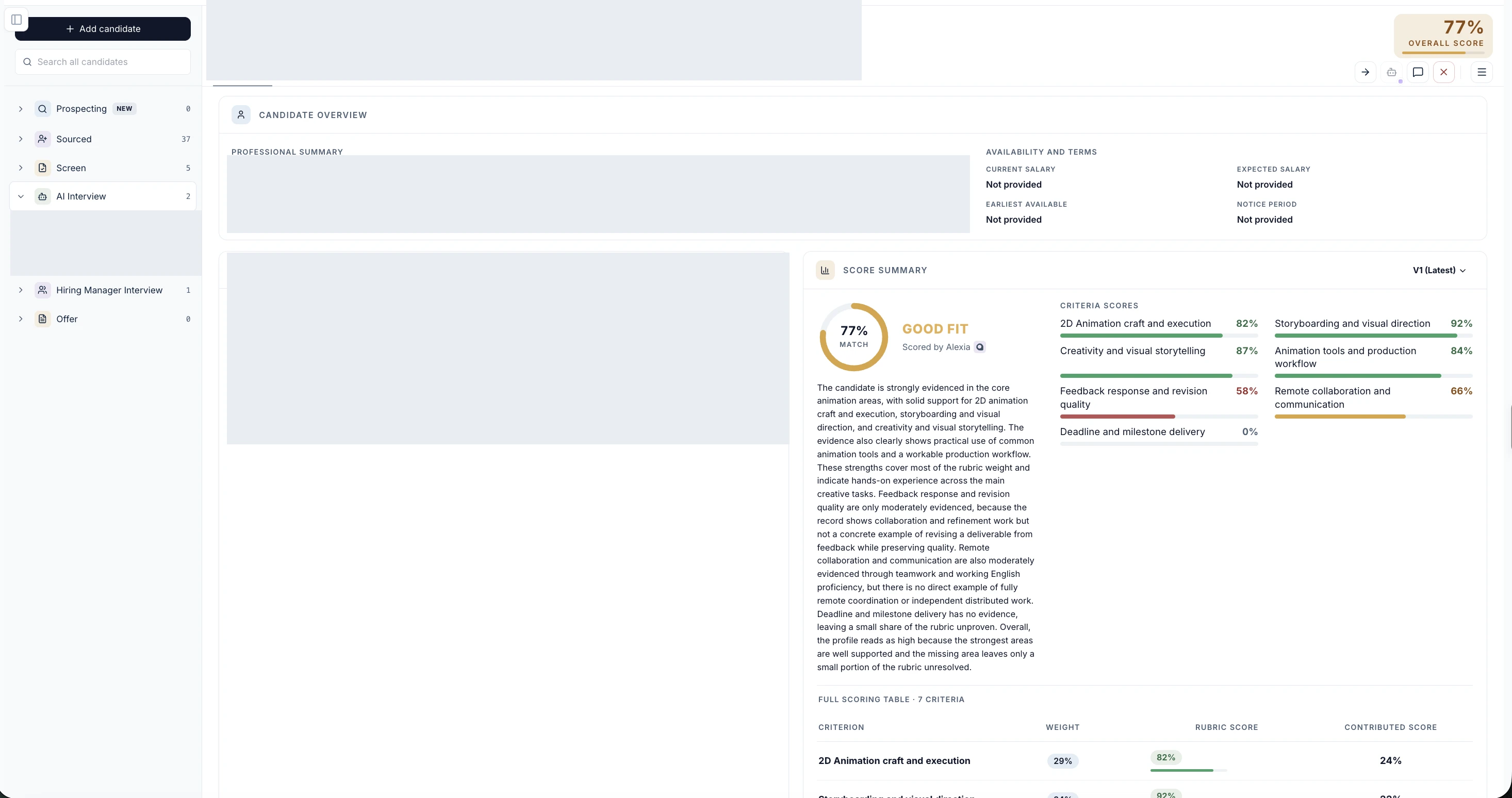
Candidate names, contact details and other identifying information have been permanently obscured. The assessment shows a 77% overall match and a missing-evidence gap for deadline and milestone delivery.
Missing evidence doesn't always mean a candidate lacks a skill. It means the hiring team needs more information.
The available case-study information does not establish whether this applicant progressed further.
How transparent AI scoring supports better hiring decisions
A candidate match score should help recruiters understand an assessment, not replace their judgment.
Teamified evaluates candidates against a job-specific scoring rubric.
Each criterion has an assigned weight, allowing hiring managers to review how individual assessment results contribute to the overall score.
Recruiters can examine:
- Skills and experience demonstrated by the candidate
- Results against the job's scoring criteria
- Supporting evidence behind the assessment
- Missing qualifications requiring verification
- Questions worth exploring in the next interview
This gives hiring teams more context than a single match percentage.
It also helps them identify which candidates deserve further consideration and what information still needs to be verified.
AI handles the repetitive work. Humans make the hiring decisions.
AI recruitment automation helps reduce the administrative tasks involved in hiring.
In this example, Teamified handled application screening, scoring, AI interviews, and automated pipeline updates.
The hiring team remained responsible for evaluating candidates and making employment decisions.
The result was a recruitment workflow that helped the business identify a candidate for further consideration without manually managing each stage.
Frequently asked questions about AI recruitment automation
AI recruitment automation uses artificial intelligence to manage repetitive hiring tasks such as resume screening, candidate scoring, interviews, and recruitment pipeline updates. It helps hiring teams assess applicants while retaining human oversight of hiring decisions.
Yes. AI candidate screening software can evaluate applications against predefined job requirements. With Teamified, recruiters configure the criteria and workflow rules used to assess applicants and determine who progresses.
Processing times vary by job requirements and workflow configuration. In this Teamified customer example, one applicant reached the hiring manager's shortlist in 32 minutes, including a 12-minute-and-31-second AI interview.
Yes. AI interview agents can ask job-related questions, collect candidate responses, and generate assessments for recruiters to review. These interviews support the hiring process but do not replace human decision-making.
Teamified uses a job-specific scoring rubric with weighted criteria. Candidate assessments are linked to relevant requirements and available evidence, helping recruiters understand the results and identify missing information.
Teamified can flag missing evidence in the candidate assessment. Recruiters can then investigate the gap through follow-up questions or further verification before making a hiring decision.
No. Teamified's AI agents support recruitment through screening, scoring, interviews, and workflow automation. Hiring managers remain responsible for reviewing applicants and making final hiring decisions.
See AI recruitment automation in action
For this business, Teamified helped manage 44 job applications and move one candidate from application to shortlist in just 32 minutes.
The platform automated repetitive recruitment tasks while giving the hiring team structured candidate assessments to review.
Want to see how it could work for your next vacancy?
Explore Teamified's AI hiring platform and start building your recruitment workflow.
Client and candidate identities have been withheld to protect privacy. Results reflect this specific hiring workflow and are not guaranteed for every role.
Explore more insights

About the Author
Danielle Furini
Chief Operating Officer, Teamified
Danielle Furini is the Chief Operating Officer at Teamified, bringing over 15 years of expertise across technology, operations and global team management.
Connect on LinkedIn