
Key Takeaways
- Teamified's AI phone screening agent calls applicants who pass resume screening and asks job-specific questions generated by AI or set by the recruiter.
- The AI agent introduces itself as an AI recruitment assistant and follows the calling schedule set for each job, using the organisation's time zone.
- Recruiters can customise screening questions, dealbreakers and passing scores to suit each job.
- Recruiters can manually add any job-relevant questions needed for initial screening, not just questions about qualifications, availability or work rights. Employers still need to verify required documents.
- Teamified's AI agents handle repetitive screening tasks, while people remain responsible for final hiring decisions.
AI phone screening uses an AI agent to call job applicants who pass resume screening, ask job-specific questions and help recruiters decide who should move forward.
With Teamified, AI agents can analyse resumes, make screening calls and assess applicants against the criteria set for each role. How applicants progress depends on the settings for each stage. Recruiters review the screening evidence and apply the progression rules configured for their hiring pipeline.
It's a way to reduce repetitive screening work without taking control away from the hiring team.
What is AI phone screening?
AI phone screening is the use of artificial intelligence to conduct initial screening calls with job applicants.
Think about the questions recruiters ask during their first call.
When can you start? What are your salary expectations? Do you have the required qualifications? Are you available for the shifts we need?
These questions matter, but asking them repeatedly takes time.
An AI phone screening agent can handle these initial conversations. It asks questions based on the job requirements and helps recruiters assess whether applicants meet the criteria for the next hiring stage.
How does Teamified's AI phone screening work?
Teamified's AI agents work together across the recruitment process, from reviewing resumes to conducting screening calls.
Here's how the phone screening feature works.
1. AI agents screen resumes first
When someone applies for a job, Teamified's AI agents analyse their resume against the requirements of the role.
Recruiters can set a minimum resume score and other screening conditions.
Where automatic resume-stage progression is enabled, applicants who meet the configured conditions can move to the phone screening stage.
Passing resume screening doesn't mean someone is already qualified for the job. It means their application meets the initial criteria for further assessment.
2. Recruiters choose the screening questions
Every role has different requirements.
Screening questions might cover experience, skills, qualifications, availability, salary expectations or other requirements relevant to the role. These are examples, not a fixed list of supported topics.
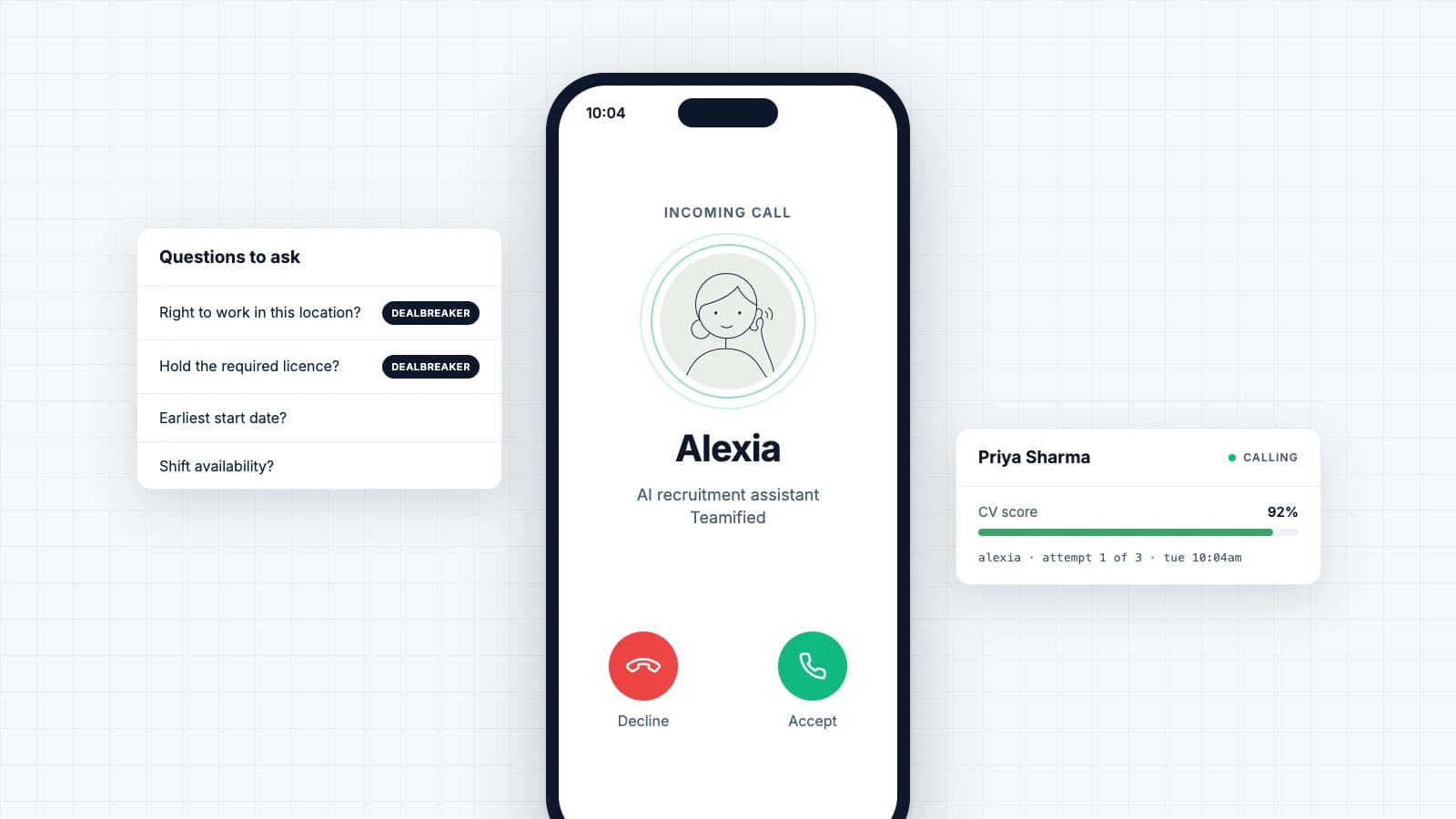
Questions can be generated by Teamified's AI agent or set by the recruiter. Recruiters can manually add and customise the questions they need for initial screening.
They can also configure screening criteria, minimum passing scores and dealbreakers that affect how an applicant is assessed. Any review requirements for the stage still apply.
3. Teamified's AI phone screening agent makes the call
Once applicants pass resume screening and reach the configured phone screening stage, the AI agent can call them.
It introduces itself as an AI recruitment assistant and asks the questions set for that job.
Recruiters can configure when calls happen and how many attempts the agent makes. Calling windows use the organisation's time zone, not the applicant's local time. Recruiters should consider applicants' locations when choosing calling hours.
Confirm the effective calling and retry settings before activating a job. Also confirm when further calls stop or pause, including after a completed call, a refusal, withdrawal, booking, reply, stage change or recruiter hold.
Recruiters should review applicants who cannot be reached after the configured attempts and decide the appropriate next step.
4. Recruiters review the screening results
After the screening call, Teamified's AI agents use the configured criteria to assess the results.
Recruiters review the answers, check any dealbreakers and decide which applicants should move forward. Confirm which stages require recruiter review before applicants progress. Automatic progression during resume screening does not by itself determine what happens after the phone screen.
A screening score or an applicant's answer is not a substitute for reviewing the evidence or verifying required documents. Their verbal answers do not replace the need to verify supporting documents.
Since businesses can customise their hiring pipelines, the next stage depends on how each job is configured. It could be another assessment, an interview or another step in the recruitment process.
The hiring team remains responsible for the final hiring decision.
Manual vs AI phone screening: What's the difference?
Both methods help recruiters gather information before progressing an applicant. The main difference is who handles the initial conversation.
| Screening task | Manual phone screening | AI phone screening |
|---|---|---|
| Making calls | Recruiter calls each applicant | AI agent makes the calls |
| Asking questions | Recruiter asks the questions | AI uses configured job-specific questions |
| Screening consistency | Depends on the recruiter and process | Uses the configured questions and criteria |
| Call scheduling | Recruiter manages availability | Calls follow job-specific settings in the organisation's time zone |
| Unanswered calls | Recruiter follows up | Recruiter reviews applicants who cannot be reached after the configured attempts |
| Candidate progression | Recruiter reviews and updates the pipeline | Stage-specific rules determine progression and recruiter review |
| Final hiring decision | Human decision | Human decision |
AI phone screening doesn't eliminate the need for recruiters. It gives them another way to manage repetitive screening conversations, especially when multiple applicants need the same initial checks.
Why use AI phone screening in recruitment?
Spend less time on repetitive calls
Recruiters often ask the same initial questions across many applicants.
Teamified's AI agents can handle those calls, reducing the number of screening conversations recruiters need to conduct manually.
That gives hiring teams more time to review results, speak with applicants who need further assessment and work with hiring managers.
Check important requirements earlier
A resume may look promising, but it doesn't always answer practical questions.
An applicant might have relevant experience but be unavailable for the required shifts. Someone else might need a certification that wasn't clearly mentioned on their resume.
AI phone screening helps collect these details before applicants progress further.
This can help recruiters identify requirements that need clarification before arranging later interviews.
Keep screening more consistent
When several recruiters work on the same role, the questions they ask may vary.
With Teamified, hiring teams can configure a common set of questions and screening criteria for each job.
This helps applicants go through a more consistent initial screening process.
Keep review requirements clear
Automation and recruiter review can apply at different stages of the same hiring pipeline.
Define where AI can automate repetitive steps and where recruiter review is required. Review requirements can differ between resume screening and phone screening.
Check the requirements for each stage rather than assuming the same progression rules apply throughout the pipeline.
What do applicants experience during an AI phone screening call?
Applicants who reach the configured screening stage may receive a call from Teamified's AI phone screening agent.
The agent introduces itself as an AI recruitment assistant and asks questions relevant to the job.
For example, it might ask when they can start, whether they have a required certification or what days they are available to work.
The questions depend on the requirements the hiring team has configured.
The length of the call may vary depending on the number and type of questions. Applicants may also have different responses or require clarification.
Hiring teams should make sure applicants know how to contact a person if they need assistance, and explain how screening information is collected and used under the applicable privacy notice.
AI screening is intended to support the recruitment process, not prevent applicants from receiving appropriate human consideration.
Can AI phone screening replace recruiters?
AI phone screening can handle parts of the recruitment process, but it doesn't replace the need for human judgment.
Teamified's AI agents can analyse resumes, ask screening questions and help manage candidate progression.
However, recruiters and hiring managers still need to assess the evidence, consider the requirements of the role and make final hiring decisions.
There may also be situations where an applicant's answer needs clarification or additional verification.
The goal is to give recruiters useful information earlier, so they can focus on the decisions that need their attention.
Frequently asked questions about AI phone screening
Yes. Questions can be generated by Teamified's AI agent or set by the recruiter, then customised for each role's requirements, including availability, experience, qualifications and other job-specific criteria.
The AI agent follows the calling schedule and retry rules configured for that job, using the organisation's time zone. Recruiters should review applicants who cannot be reached after the configured attempts and decide the appropriate next step.
Progression depends on the settings for each stage. Resume-stage progression can be automated when applicants meet the configured criteria. Recruiters should check the review requirements for the phone-screening stage rather than assume the same progression rules apply throughout the pipeline.
No. Screening calls collect applicants' answers. Employers still need to verify required qualifications, work rights and other supporting documents where applicable.
Yes. The feature can be enabled for individual jobs through their hiring stages. Businesses can decide which roles should use AI phone screening.
Make your initial screening process easier
Recruitment involves more than finding people who look suitable on paper.
After resume screening, recruiters still need to check important details before deciding who should progress.
Teamified's AI agents help manage those early steps, from analysing resumes to conducting initial screening calls.
Use AI-generated questions or set your own, configure the screening criteria and confirm where recruiter review is required before applicants progress.
AI handles more of the repetitive screening work. Your team remains in control of hiring.
Post a job with Teamified and see how AI agents can support your recruitment process.
Explore more insights

About the Author
Danielle Furini
Chief Operating Officer, Teamified
Danielle Furini is the Chief Operating Officer at Teamified, bringing over 15 years of expertise across technology, operations and global team management.
Connect on LinkedIn